

Getting Started
White Papers on DLP® Technology
PLM Technology White Papers:
How It Works, Key Benefits, and Applications Notes
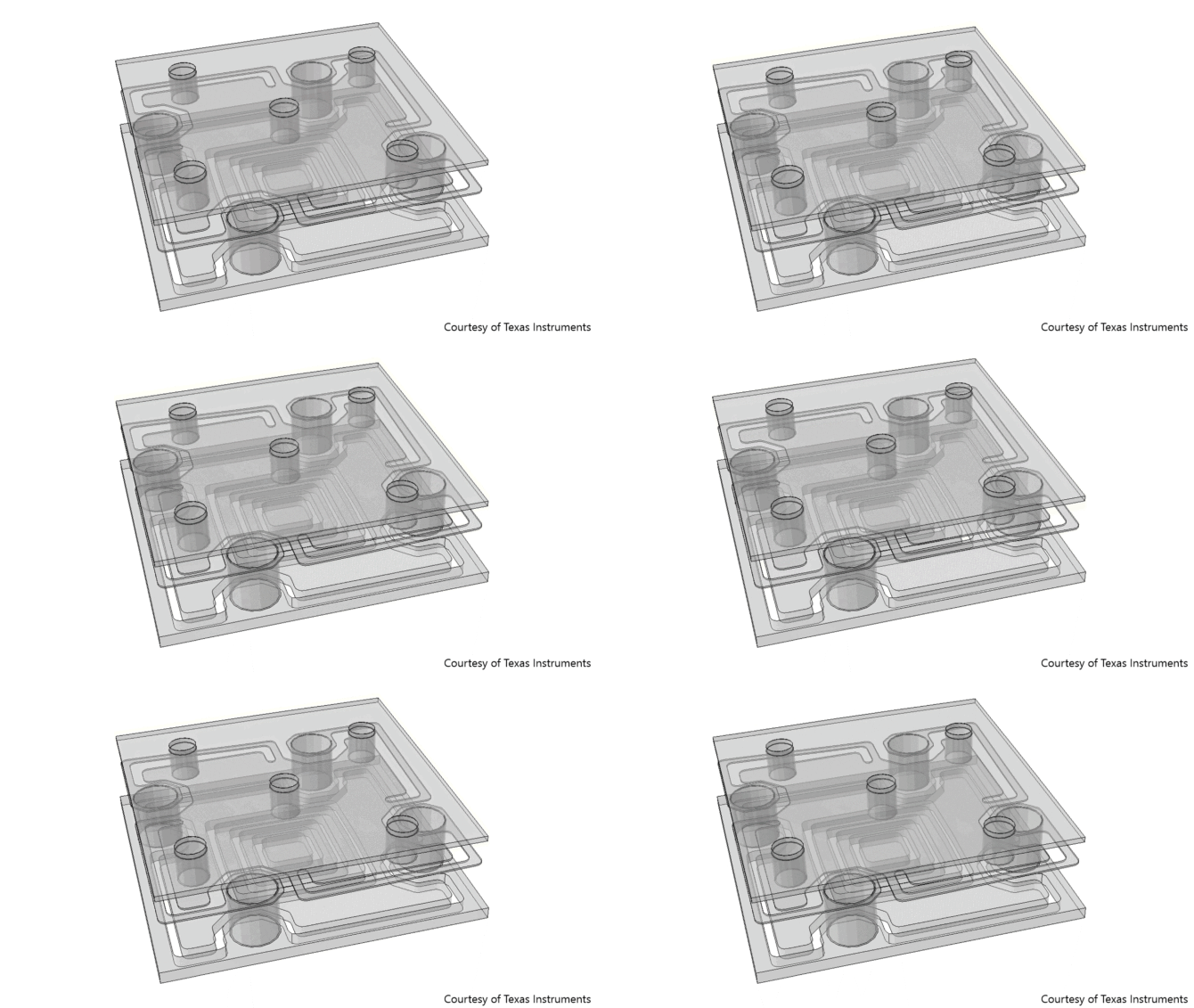
This document introduces Texas Instruments Phase Light Modulator (PLM) technology and explains how it differs from traditional binary-amplitude based DLP® Digital Micromirror Device (DMD) systems. Instead of blocking light PLMs control the optical wavefront using precise phase displacement, allowing nearly all incident laser energy to be utilized. The presentation outlines the underlying MEMS technology, pixel operation, efficiency characteristics, and reliability results and describes available chipsets across visible and near infrared wavelengths. It also highlights key application areas including holography, lithography, three-dimensional sensing and advanced laser based imaging systems, demonstrating the advantages of phase modulation for high-efficiency and high-performance optical designs.
This collection of presentations describes operational considerations for Phase Light Modulator (PLM) systems used with laser illumination. It explains the origin of 0th order light artifacts inherent to phase modulation and presents three fundamental mitigation approaches. Furthermore, the document explains mirror bias tuning, which is critical for optimizing phase displacement at different wavelengths. It details how mirror bias voltage controls mirror deflection and outlines a practical procedure to minimize 0th order energy for a given wavelength. In addition, the document provides methods for calculating optical heat load on PLM devices, including absorption in micromirrors, gaps between mirrors, and the device window materials, with examples showing how to estimate mirror temperature rise under high power operation.
This document provides a technology comparison between Texas Instruments MEMS PLMs and Liquid Crystal on Silicon (LCoS) Phase-Only Spatial Light Modulators (SLMs), highlighting the superior switching speed, the polarization independence, the higher steering efficiency and the outstanding optical stability and reliability of MEMS PLMs.
DMD Technology White Papers:
How It Works, Key Benefits, and Applications Notes

This document provides a foundational overview of Texas Instruments DLP® Digital Micromirror Device (DMD) technology, covering the structure, electrical and mechanical operation, and basic array behavior of ±12° orthogonal micromirrors used in DLP® systems. It explains how individual micromirrors are controlled by underlying CMOS memory and mirror clocking pulses, how rows and blocks of data are loaded and displayed, and how phased and block operations enable high-speed pattern display. This document is designed to help engineers understand the core mechanics and signal control of DMDs for high-speed industrial, medical and display applications.
This application report explains the key geometric optics principles relevant to DLP® systems using Digital Micromirror Devices (DMDs). It answers common optical design questions by covering aspect ratio definitions, lens types, imaging fundamentals, focal length, aperture effects, throw ratio, magnification, and DMD placement in projection systems. This report helps engineers understand how optical components, such as simple and complex lenses, affect projected image size, brightness, and system performance when designing DLP light engines and projection optics.
This presentation provides practical optical design guidelines for systems using DLP® Digital Micromirror Devices (DMDs). It explains key considerations for illumination and projection optics, including telecentricity, numerical aperture matching, étendue conservation, micromirror tilt geometry, and pupil alignment. The document outlines recommended illumination architectures, chief ray angle control, and contrast optimization techniques to maximize efficiency, uniformity, and image quality. These guidelines help optical and system designers properly integrate DMDs into projection, industrial, and advanced imaging applications while maintaining performance and reliability.
This application report explains how the transmission characteristics of DLP® Digital Micromirror Device (DMD) windows affect optical efficiency across different wavelength regions. It outlines how window materials and their anti-reflective (AR) coatings influence transmission in ultraviolet (UV), visible (VIS), and near-infrared (NIR) bands. The report provides measured transmittance curves showing typical single-pass transmission as a function of wavelength. This information helps optical system designers to estimate overall DMD efficiency, including window transmission, diffraction efficiency, and micromirror reflectivity, based on the illumination source wavelength and angle of incidence.
This application note provides practical system design guidance for using DLP® Digital Micromirror Devices (DMDs) with ultraviolet A (UVA) light in advanced imaging, direct imaging lithography, and 3D printing systems. It explains design factors such as thermal management, micromirror duty cycle, optical f number matching, and high demagnification optics needed to maintain performance and reliability with higher energy UVA sources. The document also discusses how incoherent and coherent light sources affect system efficiency and diffraction behavior, offering optical alignment and aperture recommendations to optimize light delivery and image fidelity in UVA DLP designs.
This white paper explains how DLP® Digital Micromirror Device (DMD) technology behaves when used with laser light sources. It shows that a DMD acts like a two-dimensional diffraction grating and describes the principles of diffraction and blaze conditions that affect light distribution when coherent or semi coherent sources are used. It covers intuitive diffraction concepts, formulas for blaze angles and how incident angle, wavelength, and pixel pitch determine diffraction order intensity. It also details advantages and design considerations for integrating lasers in DLP® based optical systems to optimize light efficiency and image quality.
This application note explains how to calculate temperature rise in DLP® Digital Micromirror Devices (DMDs) under both continuous wave (CW) and pulsed illumination conditions. While thermal behavior under CW illumination can be determined using straightforward equations provided in DMD datasheets, pulsed illumination introduces transient heating effects that require more advanced thermal modeling. Because DMD mirror heating times can exceed the optical pulse duration, a transient thermal model is necessary to accurately predict micromirror surface and bulk temperature rise. The document presents equations for analyzing DMD thermal response as a function of pulse duration and pulse repetition rate, helping designers ensure micromirror temperatures remain within reliable operating limits in pulsed light applications.
This application report helps engineers design high power optical systems using DLP® Digital Micromirror Devices (DMDs) by explaining key thermal management and heat load calculations. It focuses on maintaining safe DMD operating temperatures when using high power near infrared light sources such as lasers. The guide covers how to calculate mirror array and package temperatures based on incident optical power, electrical dissipation, and thermal resistance from the silicon die to the package. It also explains how to assess heat absorption on active mirror areas, window glass, and dark metal areas, and provides examples showing how to compute temperature rise under uniform and partial illumination. In addition, the document discusses cooling strategies including heatsinks and forced air window cooling to keep DMD temperatures within reliable limits for high power applications.
